

Opening Altar Prayer: A Simple Guide to Begin Worship
Have you ever stood before an altar and wondered what to say first? That quiet pause can feel meaningful, but it can also bring uncertainty—especially if you are beginning a new spiritual practice or returning after time away. An opening altar prayer does not need to be elaborate or perfect. It simply marks your intention to become present, respectful, and receptive.
This guide explains what an altar-opening prayer means, how to prepare your space, and how to write or speak words that feel authentic to you. You will also find a simple prayer example, a step-by-step opening ritual, ethical considerations, and grounded ways to carry your reflection into everyday life.
What Is an Opening Altar Prayer?
An opening altar prayer is a short invocation spoken at the beginning of worship, meditation, spiritual reflection, or ritual. Its purpose is to create a conscious transition from ordinary activity into sacred attention. You might use it to express gratitude, ask for clarity, honor your spiritual tradition, or dedicate the time to healing and thoughtful reflection.
In plain language, you are saying: I am here, I am paying attention, and I enter this moment with respect. You do not need special objects, memorized words, or a particular belief system. If your space feels distracted or emotionally heavy, you may first tidy it, breathe slowly, or consider a personal practice related to spiritual cleansing support.
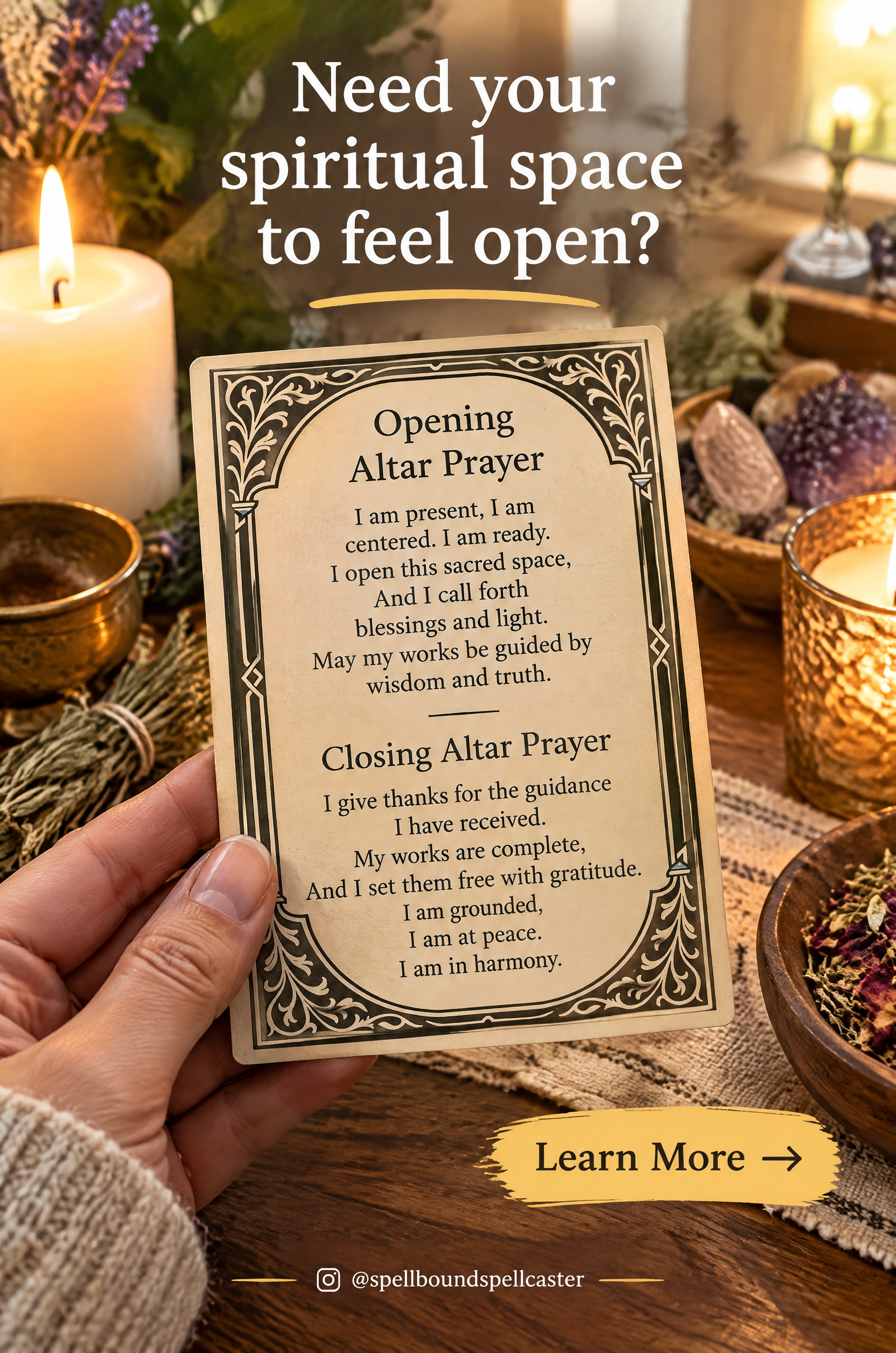
A calm altar setting represents the transition from everyday concerns into intentional prayer and reflection.
Why You May Feel Drawn to Begin Worship at an Altar
An altar can serve as a visual anchor for attention. When life feels crowded with obligations, placing yourself before a meaningful space may help you slow down and recognize what you are carrying emotionally.
You might feel called to an altar practice because you want to:
- Begin prayer with greater focus and consistency.
- Express gratitude or acknowledge an important transition.
- Honor a spiritual path, loved one, ancestor, or personal value.
- Create a peaceful boundary between reflection and daily activity.
- Seek clarity without demanding a predetermined answer.
- Dedicate time to emotional release, forgiveness, or renewal.
Some people keep a permanent altar, while others arrange a temporary space using a cloth, meaningful photograph, natural object, written intention, or other personally appropriate symbol. Your altar does not have to resemble anyone else’s. It should reflect your values, beliefs, and practical circumstances.
Do you need a formal altar to pray?
No. A windowsill, small table, shelf, or clear area on the floor can become a place of focused reflection. You can also pray without any physical altar at all. The essential element is your sincere attention, not the size or appearance of the space.
If your intention extends to creating a calmer atmosphere throughout your living space, you may also wish to explore the idea of a home blessing and land-clearing ritual as a separate form of private spiritual support.
How Intention and Symbolism Shape Altar Prayer
Intention gives your prayer direction. It does not guarantee an external result, nor does it place life under your control. Instead, an intention identifies the quality you want to practice: patience, honesty, courage, compassion, discernment, gratitude, or peace.
Before opening your altar, ask yourself one thoughtful question: What quality do I want to carry away from this sacred moment and into the rest of my day?
Your answer can guide both your words and your choice of symbols. Water may represent renewal, a stone may suggest steadiness, a written name may express remembrance, and a light may symbolize hope or awareness. These meanings are personal and may differ between cultures and spiritual traditions.
How do I set an intention before prayer?
Choose one clear sentence focused on your own participation. For example: “I intend to listen with patience,” or “I dedicate this time to understanding what I can change and accepting what I cannot control.” Keeping the intention centered on your conduct supports emotional responsibility and respects other people’s autonomy.
Can an altar prayer honor ancestors?
Yes, if ancestral remembrance is welcome within your beliefs and culture. You might speak names, offer gratitude for life and lessons received, or ask to embody the wisest values passed down to you. Avoid claiming messages or certainty that you have not genuinely experienced.
Those drawn to this form of reflection can consider ancestral blessing and guidance support, while remembering that spiritual experiences are personal and vary from one individual to another.
A Simple Opening Altar Prayer You Can Use
The following prayer is intentionally broad so you can adapt it to your faith, spiritual language, or personal philosophy:
“With gratitude, I enter this sacred moment.
May this space be held in peace, honesty, and respect.
May my thoughts become clear, my heart remain compassionate, and my choices reflect wisdom.
I welcome only what supports understanding and the highest good, while honoring the freedom and dignity of every person.
May I listen carefully, reflect sincerely, and carry what I learn into responsible action.
With humility and trust, I begin.”
You may replace “sacred” with another word, address a deity or spiritual presence according to your tradition, or shorten the prayer to one line. Spoken words, silent words, and written prayers can all be meaningful.
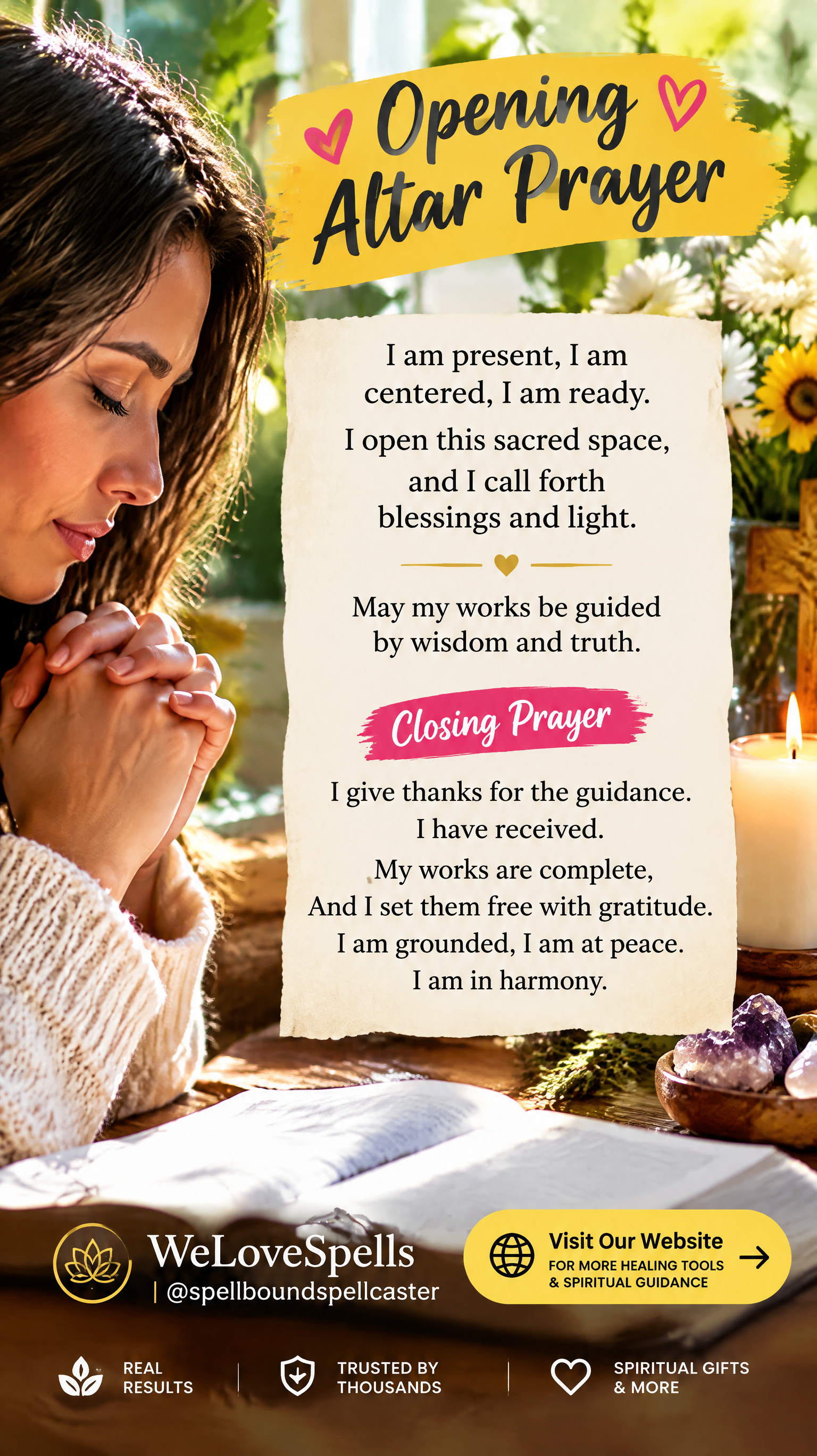
An intentionally prepared altar can support concentration, gratitude, and a grounded beginning to worship.
How to Begin an Altar Ritual Step by Step
You can use this simple process for daily worship, occasional reflection, or the beginning of a longer ritual. Adapt every step to your mobility, privacy, safety, beliefs, and available time.
- Prepare the area. Remove clutter and place only the objects that support your intention. If you use candles or incense, follow fire-safety rules and consider children, animals, ventilation, and allergies.
- Settle your body. Sit or stand comfortably. Take three unforced breaths and notice the physical support beneath you.
- Name your intention. Say one sentence describing why you have come to the altar. Keep it honest and focused on reflection rather than control.
- Acknowledge your boundaries. Affirm that your practice will honor consent, personal choice, dignity, and the well-being of everyone involved.
- Speak the opening prayer. Use the example above, words from your tradition, or your own simple invocation.
- Pause in silence. Give yourself a minute to notice thoughts and feelings without treating every passing impression as a command or prediction.
- Continue your practice. Pray, journal, meditate, express gratitude, or reflect on a meaningful passage.
- Close deliberately. Offer thanks, state one practical next step, and safely extinguish any flame before leaving.
If a sense of spiritual safety is important to your practice, you may gently explore a private protection ritual. This can accompany personal reflection, but it should not replace ordinary precautions, healthy boundaries, or practical decision-making.
Emotional Grounding and Realistic Expectations
Prayer can provide structure for hope, grief, gratitude, or uncertainty, but it is not a way to guarantee events. You may finish an altar practice feeling peaceful, emotional, unchanged, or simply more aware of what needs attention. Each of these responses can be valid.
A meaningful ritual may help you clarify your priorities, but practical action still matters. If you pray for reconciliation, for example, your next responsible step might be listening, apologizing where appropriate, or respecting another person’s boundaries. If you pray for a new opportunity, it may help to update your plans, seek information, and take one manageable action.
Do not pressure yourself to interpret every coincidence, dream, or emotion as a definite sign. Spiritual reflection can remain open-ended. For readers contemplating patience and life’s unfolding, divine timing alignment support offers another ritual option to consider without promising a specific outcome.
What if I feel distracted during prayer?
Distraction is normal. Notice it without criticism, return your attention to your breathing, and repeat one line of your prayer. A sincere two-minute practice may be more grounding than a long ceremony performed under pressure.
Ethical Prayer, Consent, and Personal Choice
A respectful altar practice does not seek to override another person’s feelings, choices, communication, or behavior. Center your prayer on qualities you can cultivate and outcomes that leave room for everyone’s autonomy.
Instead of asking that someone be compelled to respond in a certain way, you might pray for clear communication, mutual understanding, wise boundaries, or the strength to accept the truth. This approach protects dignity while helping you remain connected to your own values.
You are also free to stop, revise, or decline any practice that conflicts with your beliefs. Spiritual support should be chosen thoughtfully, never from fear or outside pressure. If you are interested in developing reflective awareness, you may wish to review intuition-focused spiritual support while continuing to use careful judgment in everyday decisions.
Practical Actions That Complement Spiritual Reflection
An altar prayer becomes especially meaningful when its intention appears in your conduct. After worship, choose one realistic action that reflects what you prayed for.
- Write down one insight and one question that remains unresolved.
- Have a calm, respectful conversation where communication is appropriate.
- Make an apology without demanding forgiveness in return.
- Create a boundary that protects your time, values, or well-being.
- Complete one small task connected to your hope or goal.
- Rest before making a major decision if you feel emotionally overwhelmed.
- Return to factual information when interpreting uncertain situations.
These actions do not make prayer less spiritual. They allow reflection and responsibility to work together.
What to Consider Before Choosing This Support
Before choosing private ritual support, pause and identify what you genuinely want from the experience. Are you looking for a symbolic beginning, dedicated spiritual attention, emotional clarity, or a way to mark a transition? A clear purpose can help you choose without expecting certainty or control.
Consider the following:
- Personal alignment: Does the service fit your beliefs and values?
- Consent: Does your intention respect the choices and dignity of others?
- Expectations: Can you approach the ritual knowing experiences and results vary?
- Practical responsibility: What real-world steps will accompany your spiritual reflection?
- Emotional readiness: Are you choosing freely rather than reacting to pressure or fear?
A ritual can hold symbolic meaning without guaranteeing the outcome you hope for. Give yourself permission to take time, compare appropriate forms of support, or continue with a personal altar practice instead.
How Private Online Ritual Support Works
We Love Spells provides private online spiritual and ritual services. After ordering, clients provide relevant personal details so the work can be personalized. Belinda personally performs the ritual work, and clients receive a private update after casting.
Remote rituals are performed privately, and no physical item is shipped for a remote ritual service. Spiritual experiences and results vary, and We Love Spells does not guarantee a particular outcome.
If you are considering outside support, you can gently browse We Love Spells and its available private ritual services. Take the time you need to decide whether this form of support feels appropriate for you.
Frequently Asked Questions
What should I say when opening an altar?
Begin with gratitude, name your intention, and ask for qualities such as clarity, compassion, peace, or wisdom. Your words can be brief: “I enter this time with respect and ask for clarity as I reflect.”
How long should an opening prayer be?
There is no required length. A prayer may last less than a minute or form part of a longer ceremony. Clarity and sincerity matter more than duration.
Can I write my own altar-opening prayer?
Yes. Use language that reflects your beliefs and emotional needs. Include an acknowledgment of the sacred moment, your purpose, an ethical boundary, and the qualities you hope to practice.
Do I need candles, incense, or special tools?
No. Ritual objects are optional symbols rather than requirements. If you use them, choose items thoughtfully and observe practical safety precautions.
Can I use the same prayer every day?
Yes. Repetition can create a steady rhythm and make it easier to settle into reflection. You can also change one sentence each day to match your current intention.
What should I do after the prayer?
Continue with worship, silence, journaling, meditation, or gratitude. When you finish, close the practice deliberately and choose one grounded action that expresses your intention.
Begin Your Opening Altar Prayer With Trust and Simplicity
An opening altar prayer is not a performance. It is an invitation to become attentive—to your spiritual values, your emotions, and the choices available to you. A clear intention, a few honest words, and a respectful pause are enough to begin.
Let your practice evolve naturally. Keep what brings you peace and integrity, revise what no longer fits, and allow uncertainty to exist without forcing an answer. Most importantly, carry the compassion and wisdom you seek at the altar into your relationships and daily decisions.
If private ritual support feels aligned with your path, you may explore a white-light emotional healing ritual when you feel ready. Approach it as spiritual support for reflection rather than a promised result, and choose only what feels respectful, grounded, and true to you.