

Energy Cleansing Ritual: A Simple Guide to Clear Your Space
Does your home ever feel heavy after an argument, a stressful week, an illness, or a major life change—even after you have cleaned every visible surface? It is understandable to want a gentle way to mark a fresh beginning. An energy cleansing ritual can create a quiet pause in which you clear your surroundings, settle your thoughts, and choose what you want your space to represent.
This guide explains how to cleanse your space with simple, accessible steps. You will also learn how intention and symbolism fit into the process, what results are realistic, and when private support such as a personalized cleansing spell may feel appropriate.
What Is an Energy Cleansing Ritual?
An energy cleansing ritual is a symbolic practice used to release a sense of emotional heaviness and establish a calmer atmosphere. It might include opening windows, tidying a room, making sound, sitting in reflection, or speaking an intention aloud.
The purpose is not to prove that something invisible is present or to guarantee that every difficulty will disappear. Instead, the ritual gives you a deliberate way to acknowledge how a place feels, take practical action, and redirect your attention toward peace, clarity, or renewal.
In simple terms, you clean what you can physically, pause to notice what you are carrying emotionally, and use meaningful actions to welcome a different feeling into the space.
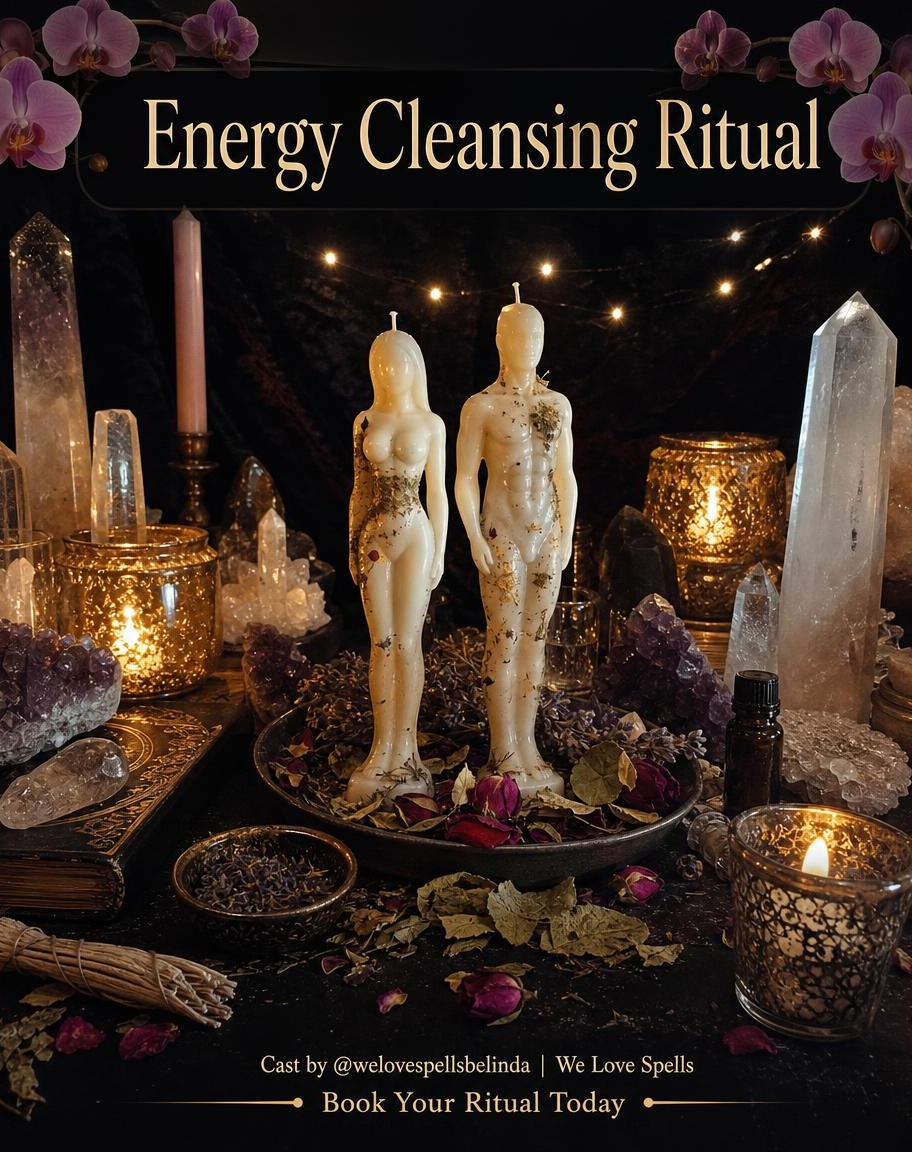
A calm ritual setting can represent release, reflection, and a conscious new beginning for your space.
Why You May Feel Drawn to Cleansing Your Space
People often seek a space-clearing ritual during transitions. A home can hold reminders of conversations, routines, relationships, and difficult seasons. Even when the surrounding objects have not changed, your emotional relationship with the room may have changed considerably.
You may feel drawn to cleansing after:
- A tense conversation or period of conflict
- A breakup, separation, or change in a relationship
- Moving into a new home or rearranging a familiar room
- Receiving visitors whose presence felt unsettling
- A demanding period at work or within the family
- Letting go of possessions connected to the past
- Feeling distracted, stagnant, or emotionally overwhelmed
Wanting to reset does not mean your home is dangerous or that something is wrong with you. Sometimes you simply need an intentional boundary between what happened before and what you want to cultivate next.
How do you know when your space needs an energy reset?
There is no universal test. You might notice that one room makes it harder to relax, that clutter has become emotionally draining, or that your surroundings no longer feel aligned with your current needs.
Begin with ordinary explanations. Consider light, airflow, noise, cleanliness, unfinished tasks, and stressful associations. Addressing these practical concerns is not separate from spiritual reflection; it can be an essential part of restoring comfort.
How to Perform a Simple Energy Cleansing Ritual
You do not need elaborate tools to create a meaningful ritual. Choose a time when you are unlikely to be interrupted, adapt every step to your home, and avoid any object or practice that feels uncomfortable or unsafe.
- Decide what you are releasing. Name the feeling or pattern you are ready to leave behind. You might write, “I release the tension connected with this room,” rather than focusing on controlling another person or predicting an outcome.
- Clean and simplify the area. Remove rubbish, put away out-of-place items, wipe surfaces, and attend to neglected corners. Physical order can support the sense that you are actively caring for your environment.
- Invite in fresh air and light. Open windows or curtains when weather and safety allow. If that is not possible, turn on a gentle light and spend a few moments breathing slowly.
- Move through the space mindfully. Walk around the room at an unhurried pace. You can clap softly, ring a bell, play peaceful music, or simply use your voice. Sound is optional; silence can be equally meaningful.
- State a clear intention. Use words that reflect your own choices: “May this home support rest, honesty, and peaceful boundaries.” Keep the focus on qualities you can welcome rather than behavior you want to force from someone else.
- Pause at the center. Stand or sit quietly and notice what has changed. The difference may be subtle: more space, slower breathing, or a clearer awareness of what needs attention.
- Complete one grounding action. Wash your hands, drink water, take a shower, prepare a meal, or step outdoors. This marks the end of the ritual and returns your attention to everyday life.
What can you use to cleanse a room?
Your presence and intention are enough. Optional tools may include a bowl of water, a meaningful cloth, gentle music, a bell, flowers, or a written affirmation. If you use candles, smoke, herbs, or fragrance, consider fire safety, ventilation, allergies, children, pets, building rules, and the comfort of everyone sharing the home.
No particular object is automatically more powerful or authentic. A simple practice you understand and feel comfortable performing is often more supportive than a complicated ceremony copied without personal meaning.
Intention, Symbolism, and Emotional Grounding
Intention gives the ritual direction. Instead of vaguely wishing for the space to feel “better,” identify the quality you want to practice there. It could be calm communication in a shared kitchen, deeper rest in a bedroom, or concentration in a workspace.
Symbolism helps turn that intention into an action you can see and remember. Opening a window may symbolize release. Rearranging furniture can represent making room for change. Placing a meaningful object near the doorway may remind you of the boundaries you have chosen.
Reflection question: When you enter this space, what feeling would you like to experience—and what practical change could help support it?
Grounding keeps the ritual connected to the present. Notice the floor beneath your feet, the temperature of the air, and the sounds around you. If you become more distressed during the practice, stop, move to a comfortable place, and choose a familiar activity that helps you settle.
What should you say during an energy cleanse?
Your words can be spiritual, secular, or somewhere in between. Speak in a way that feels sincere rather than dramatic. For example: “I acknowledge what has happened here. I release what I no longer need, and I choose to care for this space with steadiness and respect.”
If your feelings extend beyond the room and you are seeking a symbolic practice centered on personal release, you may also wish to explore cord-cutting ritual support. This should be approached as reflection and boundary-setting, not as a way to control another person.
Practical Actions That Support Spiritual Reflection
A ritual can feel more meaningful when it is followed by choices that support the intention. If you welcome calm but continue tolerating avoidable chaos, the effect of the moment may be difficult to carry into daily life.
Depending on your situation, complementary actions might include:
- Repairing or removing an item that repeatedly creates frustration
- Creating a regular cleaning and decluttering routine
- Reducing noise, visual clutter, or unnecessary notifications
- Moving emotionally charged belongings into storage until you can review them calmly
- Setting respectful household boundaries around privacy and shared areas
- Having an honest, non-accusatory conversation with someone who shares the space
- Adding a restful activity such as reading, journaling, stretching, or quiet music
If the whole home feels connected to a transition, the home blessing and land-clearing service is another private spiritual option to consider. If your concern is more personal than location-based, you can gently compare it with long-distance aura cleansing before deciding what best reflects your intention.
Realistic Expectations After a Space-Clearing Ritual
You may feel lighter, calmer, or more focused after cleansing your home. You may also feel very little immediately. Both responses are valid, and neither proves that you performed the ritual correctly or incorrectly.
A cleansing practice cannot guarantee that conflict will end, another person will behave differently, or external circumstances will change. It is best understood as a personal and symbolic reset that can help you reflect on what belongs within your control.
Sometimes a ritual reveals the next practical step rather than resolving the entire concern. You may realize that you need to organize a neglected area, communicate a boundary, change a routine, or give yourself more time to process a transition.
How often should you cleanse your space?
There is no required schedule. Some people cleanse at the beginning of a season, after visitors, following a difficult event, or when moving home. Others prefer a brief weekly reset.
Avoid letting the practice become driven by fear. Repeated cleansing is not a substitute for addressing persistent household problems. One intentional ritual, followed by practical care, may be more grounding than constant repetition.
Ethics, Shared Spaces, and Personal Choice
A respectful ritual centers on your own intentions and the atmosphere you wish to encourage. It should not be used to frighten household members, label someone as spiritually harmful, or claim authority over another person’s beliefs.
If you share your home, consider how sound, smoke, scent, and rearranged belongings may affect others. You can quietly cleanse your own room or personal area without requiring anyone else to participate. Consent and consideration matter, even within spiritual practice.
You are also free to adapt or omit any traditional element. Spiritual symbolism is personal, and there is no need to perform an action that conflicts with your values, culture, health needs, or living situation. If you want a broader symbolic sense of safety after cleansing, private protection ritual support is available as a separate option, without any promised outcome.
What to Consider Before Choosing This Support
Before arranging a private ritual, pause and clarify what you are truly seeking. Is your intention to mark a new beginning, release emotional weight, bless a home, or focus on your personal sense of renewal? A precise, respectful intention can make it easier to choose appropriate support.
Consider the following:
- Your focus: Decide whether the concern relates mainly to you, one room, or the wider home.
- Your expectations: Look for reflection and symbolic support rather than certainty or guaranteed change.
- Your practical needs: Address cleaning, repairs, communication, and boundaries alongside ritual work.
- Your comfort: Choose only an approach that respects your beliefs and personal autonomy.
- Your emotional state: Give yourself time to decide rather than ordering from panic or pressure.
If your main intention is compassionate inner renewal, the white-light emotional healing ritual may be a more fitting form of symbolic support than a home-focused service.
How Private Online Ritual Support Works
We Love Spells provides private online spiritual and ritual services. Remote rituals are performed privately, and no physical item is shipped for a remote ritual service.
After ordering, clients provide relevant personal details so the work can be personalized. Belinda personally performs the ritual work, and clients receive a private update after casting.
Spiritual experiences and results vary. We Love Spells does not guarantee a particular outcome. Private ritual support is therefore best chosen as a meaningful spiritual service, not as a promise that a specific event will occur.
Frequently Asked Questions
Can I perform an energy cleansing ritual without special tools?
Yes. Tidying, opening a window, walking through the room, speaking an intention, and sitting quietly can form a complete ritual. Tools are optional symbols rather than requirements.
How long does a home energy cleanse take?
There is no fixed duration. A single room may require only a short, focused pause, while a full-home reset may take longer because of cleaning and reflection. Avoid treating time as a measure of spiritual quality.
Can I cleanse a space without smoke?
Absolutely. You can use sound, fresh air, light, water as a symbol, music, prayer, visualization, or silence. Smoke-free options are especially useful in shared buildings and around people or animals sensitive to fragrance.
What is the difference between cleansing and protection?
Cleansing symbolically releases what feels stale or emotionally heavy. Protection focuses on reinforcing boundaries and the qualities you want to preserve. Some people perform cleansing first and then state a protective intention, but there is no mandatory order.
What if the room still feels uncomfortable afterward?
Revisit practical causes such as clutter, poor lighting, noise, unresolved conflict, or an object associated with distress. You can repeat the ritual later if it feels helpful, but you do not need to assume that discomfort proves a spiritual threat.
Can a ritual make someone else change?
No particular response or behavior should be expected or promised. Ethical spiritual reflection respects other people’s choices and focuses on your clarity, boundaries, environment, and next steps.
Create a Reset That Feels True to You
An energy cleansing ritual does not need to be elaborate to feel meaningful. By combining physical care, a clear intention, personal symbolism, and grounded reflection, you can mark a transition and consciously shape how you relate to your surroundings.
Move gently, respect everyone who shares the space, and allow your experience to be what it is. A subtle sense of order or renewed purpose can be worthwhile without needing to become proof of a guaranteed spiritual result.
If private support feels aligned with your intentions, you are welcome to explore the We Love Spells cleansing ritual service when you feel ready. Choose from a place of calm consideration, knowing that experiences vary and no particular outcome is guaranteed.